Thursday, September 18, 2008
Bird life

Having been off sick three days this week I fed the birds that arrived on our deck in the afternoon (I usually do this only early in the morning). I know some people think this is a bad idea, but I try to regulate it fairly carefully so they're not overly dependant, and try to only feed native birds, and with a variety of seed. There's at least one case - a cockatoo with a ring on his leg who initially arrived partially clipped - who wouldn't have survived without our help. He's still coming, often with lots of friends.
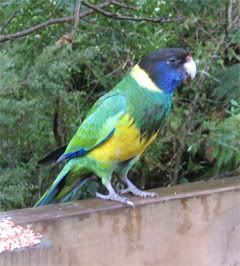
On Monday, a parrot I had never seen before appeared! J knew straight away that it was a "28 parrot," which was a name unfamiliar to me, even though my bird knowledge is very thorough. She was right, this guy is also called an "Australian ringneck" and is evidently an aviary escape. He was getting on well with the King parrots and showed up again this morning.
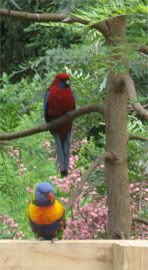
Parrots I see (or feed) on any given day at our place:

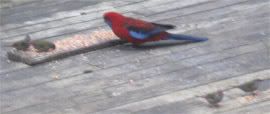
The other main seed-eating birds are red-browed finches, some bronzewings, the occasional grey currawong, blackbird, magpie or even raven, and a flock of turtle-doves, if I don't chase them off (which I always do, as they scare more easily than other birds).
What I am sick of is neighbours' cats! We never used to have any around our area, which backs onto forest, but lately a couple of toms (evidently owned) have taken to hanging around our place in search of birds, possums and other wildlife. It's infuriating, as we're trying to maintain a place that's wildlife friendly!
Friday, June 09, 2006
The Secret Life of Swans
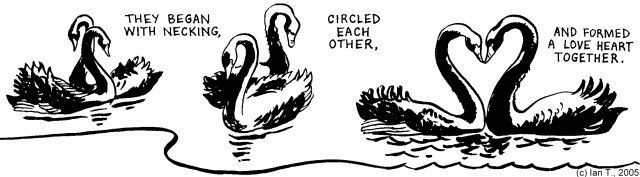
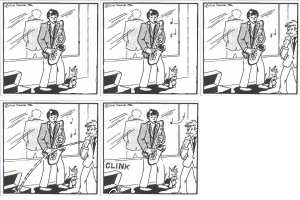
Three panel extract from Mating for Life
Last night, I read an article which confirms our observations about the sex lives of swans, which I drew as a comic page in Tango #6 last year. That piece, Mating for Life, was based on our anecdotal observations of behaviour among swan families on Lake Mulwala, Bundalong.
A team of researchers from Melbourne University, headed by Dr Raoul Mulder and Prof Mark Elgar are studying the behaviour and DNA of black swans on Albert Park Lake, with recent results revealing them to be "feathered philanderers." The article, Swan lake love-hearts, appeared in yesterday's Herald Sun.
On a sidenote, I'm not normally a Herald Sun reader, but we were eating out, having fast food... which I also don't normally eat, on the way to a concert at the alternative school our children go to, er, maybe I'll leave it there :). Anyway, the concert was wonderful, and J was still happily playing her blue violin in the car as we drove home.
OzComic 24 Hour Challenge
The OzComic 24 Hour Challenge is on this weekend. As usual, I won't be entering because I'm too old/busy/exhausted (and can't access Pulp Faction a lot of the time), but it's a great event and produces loads of wonderful comics. Quite a few past entries appeared in the Operation Funnybone book this year. If you're in Australia and have thought about making a comic, this weekend could be a good time to start!
Labels: Australian wildlife, birds, black swans, Tango
Tuesday, August 23, 2005
Reflection for Illustration Friday

Another esoteric subject for Illustration Friday :). When I got this topic I immediately thought of my reflected zebras for "Black and White," much as I thought of my "Aging" illo for "Wisdom" (which I skipped).
The topic of "Reflection" does bring up a lot of poignant ideas, but I decided to go for something real and tangible instead.
A lot of male birds seem to like fighting their reflections (which is poignant enough, when you think about it). Initially, I was going to draw a raven pecking its image reflected in a window. This happens a lot at one place I work: after screening was put on the windows to hold back the brightness the ravens spend whole days pecking at their reflections (even to pulling out the seals around the windows). The "solution" has been to install "bird spikes" - nasty, but non-lethal rows of prodding wires installed in front of the windows. Now the ravens peck a bit and get poked a lot, but it hasn't deterred them :(.
I've seen a lot of other birds exhibit this behaviour as well - mudlarks (or peewees) at the railway station, and this persistent male superb blue wren, who used to wake us up every morning buzzing the glass, when we were housesitting in Warrandyte. We have blue wrens in our own garden as well, but the light on the windows must not work well enough to conjure an imaginary rival.
Labels: Australian wildlife, birds, Illustration Friday, Sketchbook
Friday, June 10, 2005
New animals and an old bird!
 The much maligned borderline science of cryptozoology is having a bumper year so far, with the discovery of two significant new species of mammal, and the news that the ivory-billed woodpecker also appears to have survived!
The ivory-billed woodpecker is a large, iconic American bird that I remember seeing in books of rare (or extinct) creatures when I was a kid. The last confirmed sighting was 40 years ago. It's evidently an elusive species, left now only thinly distributed in the Big Woods region of eastern Arkansas. Previous sightings, which were almost invariably attributed to the pileated woodpecker, it seems, should have been believed.
 In May, came the news that a new rodent, the kha-nyou, had been discovered for sale at an Asian food market, by scientist Robert Timmins (Wildlife Conservation Society, New York City). As is usual in these cases, the locals - people of the Khammouan region of Laos - have always been familiar with the animal. It's a large rodent - around 40 cm from nose to tail - and appears to be related to South American rodents, such as guinea pigs and chinchillas, though it's not closely related to any other rodents and has been assigned its own family. As with the Vu Quang ox (a kind of goat-antelope discovered in Vietnam), it seems to be an important member of its order, providing critical information about evolution and spread of its relatives.
 Mostly recently (also in May) came the announcement of the discovery of the highland mangabey, a new species of monkey. It's apparently slightly larger than a baboon, with long cheek whiskers and a tall crest on its head (see picture), and it makes a distinctive call. Of course, it's in low numbers, and living in an isolated location - the Udzungwa Mountains of Tanzania - which is what has enabled it to survive this long. In this case it was apparently so isolated that even the locals were unaware of its existence!
Dr. Karl Shuker, author of The Lost Ark and The New Zoo, large books which compile new and rediscovered animals, will have to get busy with a new edition...
I always hope that new discoveries will lead to appropriate conservation efforts, and don't represent cases of animals being found because the last wildernesses are about to disappear!
Images & Sources:
Labels: birds, cryptozoology, new animals, new birds, new species
