Thursday, October 25, 2012
Sky for Illustration Friday

This old painting of mine was my first thought when the topic of "Sky" came up for Illustration Friday.

Originally, I planned to paint in clouds in a linear style, but the kite looked so good against a plain background that I left it this way. What surprised me was how brown the white paint appeared when applied to blue underpainting. The only solution was to add blue to the white paint before applying it, although I made the wings using a series of transparent washes, one feather at a time.
The main reason I don't paint more is that I don't have enough spare time during daylight, which it needs to work right. The picture here isn't very good, as it was taken with a flash (which I've left in on the frame), but here's an even worse attempt, taken outside on the deck tonight. I have no idea how to photograph my paintings, which is why you don't see many of them here.
Labels: Australian wildlife, Painting
Tuesday, November 23, 2010
Sneaky for Illustration Friday

This week's Illustration Friday topic suggested lots of possibilities, but this one seemed liked a simple, clear depiction of the concept of "Sneaky."
My aim was to create a picture in a different style than my usual. While I have done pictures along these lines before, I enjoy the challenge of working completely in colour with minimal linework, although this did begin as a black-and-white sketch on paper. Please click on picture for larger image.
The scenario depicted could very easily occur at Healesville Sanctuary - visitors aren't supposed to feed the birds there and the white ibis can get very aggressive in their demands for food, so it is best not to encourage them!
Labels: Australian wildlife, Illustration Friday, Melbourne Zoo
Tuesday, September 21, 2010
Acrobat for Illustration Friday

When I tried to think of something for this week's Illustration Friday topic this quickly sprang to mind.
I know I've pluralised the topic to "Acrobats", but maybe if you just focus on the top guy :). This is the flying fox equivalent of a human pyramid.
My intention was to render fur on the original sketch to make a complete black and white picture, but I scanned it in and added these colours instead. Maybe I will still finish the sketch in black and white as well, I dunno.
Labels: Australian wildlife, Illustration Friday, Sketchbook
Friday, April 24, 2009
The Last Leadbeater's Possum
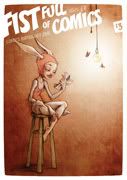 The second issue of Fist Full of Comics has just been released and it's evolving strongly, carrying the flag for Australia's independent comics anthology tradition.
As readers here will know, I've been watching the diminishing fortunes of Leadbeater's possum (mostly due to logging) for some time, and the devastating Marysville fire motivated me to produce a comics piece about the last Leadbeater's possum.
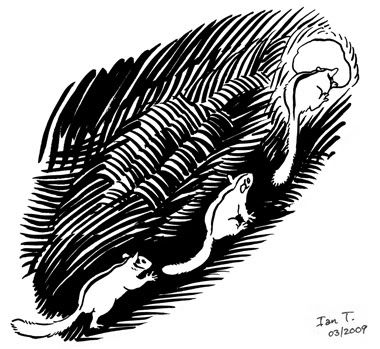 My aim was to create a flowing piece that reflected the feelings and disorientation of a fire survivor, without too much anthropomorphism. The comic page that resulted doesn't have any frames, but hopefully just draws the eye across it. The artwork was all completed in one day on 18th March. It was produced in an organic way using a lot of brushwork with some pen inking for the stark blacks, along with some pencil rubbing for the contrasting muted grey areas.
The status of Leadbeater's possum remains uncertain, though thankfully a few individuals have been found since I drew this piece. The IUCN is unlikely to upgrade its status for a while, though there can be little doubt that it should now be "Critically Endangered."
On Fist Full of Comics itself - I really enjoyed this eclectic issue, which is packed full of fine short pieces from a surprising range of Australian comic creators - nice to see so many of my favourites in there! I particularly like that the middle pages appear to have become a continuing spot for a poem/comic - in this case a beautiful moody piece by Catherine Brittle and Loren Morris. Only $3 - buy it now!
Labels: Australian comics, Australian wildlife, Comic anthologies, Fist Full of Comics, Leadbeater's possum
Monday, February 23, 2009
Leadbeater's Possum

For one species in particular, this could well spell the end. Leadbeater's possum, faunal emblem for the state of Victoria, will have been severely impacted by the extent of the fires, given that the mapped distribution of the Leadbeater's possum exactly matches the area burnt in the Kilmore East Murrundindi Rubicon Media Map of the fires.
With apparently no current captive breeding population, overseas or locally (not at Melbourne/Healesville, Perth, Taronga or any other Zoo that I can tell), there's no answer there either. The small ray of hope is that a tiny population of this relict possum formerly survived once before - coming through the 1939 fires and being rediscovered in 1965.
Flagship species do go extinct (ie: the Baiji in China in 2006) - usually with a certain amount of warning, a long period of mismanagement and a number of setbacks. Let's hope we haven't just witnessed another one.
Labels: Australian wildlife, Bushfires, extinction, Leadbeater's possum, Marysville
Sunday, January 28, 2007
Phillip Island

We've spent the Australia Day weekend recovering from a few days at Phillip Island. Actually, my days there were non-consecutive (with work in-between), but enjoyable in any case.
Naturally, the time we chose to go down there coincided with the appearance of a 6 metre (bloody big) great white shark repeatedly coming close in shore at Cowes. Even though we were in Cape Woolamai, there were (less publicised) shark warnings there as well. The changed weather conditions, with colder water, seems to have the sharks on the move in a lot of places. The apparent big concerns were this weekend and the Roxy Women’s Surf Festival at Cowes in February. Some have suggested rifles may be needed, but cooler heads have said that the great whites are only looking for snapper (too bad if you happen to bear an unfortunate resemblance to a snapper).
In any case, the most dangerous thing I did was nearly step on a big red-bellied black snake in bare feet. The animal tracks in the scrubby dunes were pretty interesting - some I had pegged as bandicoots (it looked like perfect territory for them) were actually long-nosed potoroos. Phillip Island has a strange balance of wildlife - no bandicoots, but potoroos instead, and a few other mammals - most prominently koalas and swamp wallabies (especially since the foxes have been eradicated). The birdlife is substantial, including hooded plovers (rare, and with the strange habit of nesting on the tideline).

 We went to the Fairy Penguin walk, which has gotten very built up and touristy, but seems to work pretty well. Seeing the maps showing the penguin colonies steadily
 disappearing during late last century was pretty sobering - this one is the last colony on Phillip Island, and there are far fewer elsewhere these days as well. Seeing these tiny little penguins come in with the waves at dusk is still a remarkable experience. There are still a few stupid people who attempt to photograph them, in spite of the restrictions against this.
It's worth walking the beaches in the evening to see the return of the short-tailed shearwaters - masses of them silently gliding into their burrows. Watching both the penguins and the shearwaters afforded fantastic views of Comet McNaught, which is the most impressive comet I've ever seen - very bright and close, with a huge tail.
(Penguin sketches are by J.)
Labels: Australian wildlife, Phillip Island
Friday, June 09, 2006
The Secret Life of Swans
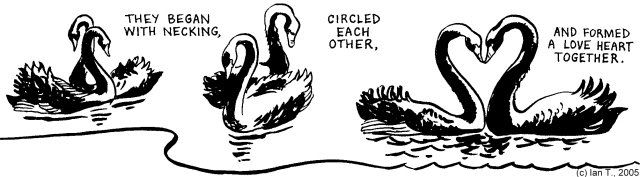
Three panel extract from Mating for Life
Last night, I read an article which confirms our observations about the sex lives of swans, which I drew as a comic page in Tango #6 last year. That piece, Mating for Life, was based on our anecdotal observations of behaviour among swan families on Lake Mulwala, Bundalong.
A team of researchers from Melbourne University, headed by Dr Raoul Mulder and Prof Mark Elgar are studying the behaviour and DNA of black swans on Albert Park Lake, with recent results revealing them to be "feathered philanderers." The article, Swan lake love-hearts, appeared in yesterday's Herald Sun.
On a sidenote, I'm not normally a Herald Sun reader, but we were eating out, having fast food... which I also don't normally eat, on the way to a concert at the alternative school our children go to, er, maybe I'll leave it there :). Anyway, the concert was wonderful, and J was still happily playing her blue violin in the car as we drove home.
OzComic 24 Hour Challenge
The OzComic 24 Hour Challenge is on this weekend. As usual, I won't be entering because I'm too old/busy/exhausted (and can't access Pulp Faction a lot of the time), but it's a great event and produces loads of wonderful comics. Quite a few past entries appeared in the Operation Funnybone book this year. If you're in Australia and have thought about making a comic, this weekend could be a good time to start!
Labels: Australian wildlife, birds, black swans, Tango
Sunday, April 16, 2006
Spotted for Illustration Friday
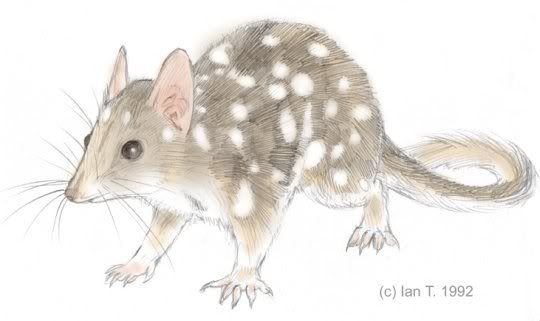
The first thing that sprang to mind for this topic for me was this beautiful animal, one of my favourites. Then I remembered I'd done a pencil sketch a long time ago, searched around and found it, and added a little bit of colour in Photoshop. The size and resolution of the pic here aren't as good as I'd like - it was done as a study in a particular pencil texture technique I was trying at the time, as this isn't clear enough to show it properly - I might replace the pic with a larger file later in the week.
This is an Eastern quoll, an animal that used to be common across eastern Australia - even to being found in the suburbs of Melbourne into the sixties, but now entirely extinct on the mainland and found only in Tasmania. If foxes become established in Tasmania, that could be the final blow. The related Western (chuditch) and Northern quolls are similarly embattled, as well as their bigger relative, the tiger quoll. Around the time I drew this I was fortunate enough to visit where Northern quolls were being studied at Monash University - they're now in decline largely due to the spread of the cane toad.
Labels: Australian wildlife, Illustration Friday, quolls
Thursday, October 27, 2005
Remote for Illustration Friday
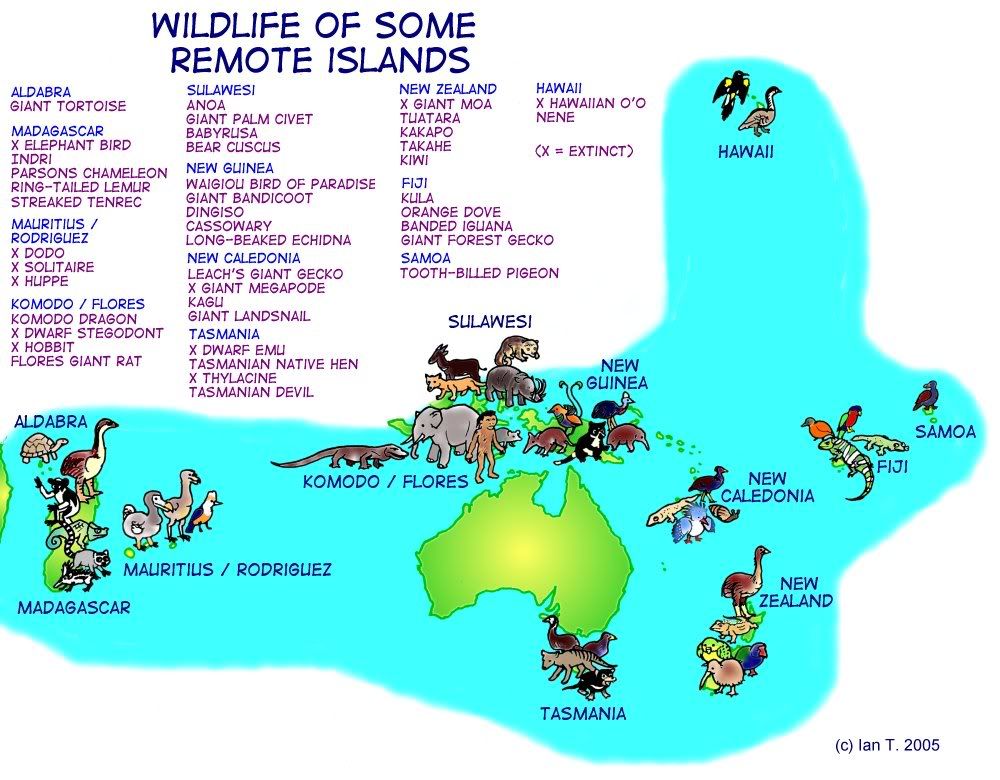
For me, "Remote" really brought up the concept of geographical isolation. Two excellent books have gotten me thinking about island zoology and biodiversity again: David Quammen's The Song of the Dodo and the beautiful photographic book South Sea Islands: a Natural History by Rod Morris and Alison Ballance. I also had a number of Tim Flannery's books in mind while composing this.
This is very much an Illustration (complete with explanatory text) rather than a work of art :). I've wanted to do maps along these lines for a while. This is actually pared down a lot - I took out quite a few, such as the Galapagos Islands, French Polynesia and even The Falkland Islands - just to make it smaller. In a sense it covers a lot of the ground followed by great naturalist Alfred Russel Wallace, the other, somewhat forgotten evolutionist whose observations in these regions brought him to the same conclusions (at the same time) as Darwin. The Southeast Asian cutoff is along the Wallace Line.
I remember a long time ago looking at pictures of eastern and western spinebills and noticing how clearly their diversification - different realizations of the same pattern - showed evolution in action. Nowhere is speciation made more clear than on remote, isolated islands. These places have to "make do" with the species that get there, either by being cut off from main landmasses at some point (allowing for the survival of primitive, relict families), or by being reachable only by swimming, flight or floating on vegetation. Following this haphazard species arrival fauna evolves into the available niches, though usually following a pattern of dwarfing of large species and enlarging small ones.
Of course, this all changes when modern people arrive, leading invariably to the high extinction rate among island species. For that reason, quite a few of the creatures shown here are extinct in comparatively recent times. However, many of them do still survive - at least until the Greenhouse Effect gets worse - and these include some of the most bizarre birds and beasties.
There is also inter-relationship between many of these species, such as the dodo and solitaire (and those mourning the dodo might like to look closely at the tooth-billed pigeon of Samoa). These three are clearly pigeon family descendants - other "arrival" species evolved from mainland species include the Fijian banded iguana and the Nene (Hawaiian goose), evidently evolved from the green iguana and Canada goose respectively.
And then there's Australian mainland - which is a study of geographical isolation all on its own - but outside the parameters I set myself here :).
Labels: Australian wildlife, cryptozoology, David Quammen, Illustration Friday, island wildlife, new animals, Tim Flannery
Tuesday, September 13, 2005
Depth for Illustration Friday

This picture really takes me back. Yes, I didn't have time/inspiration to come up with something new so, as has been suggested to me, I've decided to use an old picture of mine. Actually, I don't have a lot of early material to fall back on, because of the long period (about a decade) where I more-or-less gave up on drawing.
I drew this back in 1982 as part of a batch of illustrations for a children's book proposal. I've done quite a few of these along the way, for aspiring authors who were looking for a publishing deal. In the back of my mind I always knew that even if they got published, I'd probably be given the boot as illustrator, as that's generally the policy (in order to allocate illustrators from inhouse).
The story was a short, fairly realistic tale about a family of ringtailed possums, which I illustrated in black and white in one of my more traditional styles. Unfortunately, I don't own the originals: as usual I gave them to the author! At least on this occasion I kept photocopies of them. This image is a scan of a photocopy of an old photocopy, which does little justice to the careful linework. Oh well, I think it still tells a good story.
Illustration Friday
Labels: Australian wildlife, Illustration Friday
Tuesday, August 23, 2005
Reflection for Illustration Friday

Another esoteric subject for Illustration Friday :). When I got this topic I immediately thought of my reflected zebras for "Black and White," much as I thought of my "Aging" illo for "Wisdom" (which I skipped).
The topic of "Reflection" does bring up a lot of poignant ideas, but I decided to go for something real and tangible instead.
A lot of male birds seem to like fighting their reflections (which is poignant enough, when you think about it). Initially, I was going to draw a raven pecking its image reflected in a window. This happens a lot at one place I work: after screening was put on the windows to hold back the brightness the ravens spend whole days pecking at their reflections (even to pulling out the seals around the windows). The "solution" has been to install "bird spikes" - nasty, but non-lethal rows of prodding wires installed in front of the windows. Now the ravens peck a bit and get poked a lot, but it hasn't deterred them :(.
I've seen a lot of other birds exhibit this behaviour as well - mudlarks (or peewees) at the railway station, and this persistent male superb blue wren, who used to wake us up every morning buzzing the glass, when we were housesitting in Warrandyte. We have blue wrens in our own garden as well, but the light on the windows must not work well enough to conjure an imaginary rival.
Labels: Australian wildlife, birds, Illustration Friday, Sketchbook
Sunday, August 07, 2005
Logging to Extinction
 In weekend news, there was a report on how loggers in the Barmah State Forest have devastated over half the nesting ground of the endangered superb parrot. There are now fewer than 150 superb parrots breeding in Victoria, and they already have problems with illegal capture by collectors. As this logging has destroyed 60 per cent of their nesting colonies it severely compromises their chance of survival as a species.
The felling of 6000 tonnes of river red gums has destroyed one of the best remaining stands of old growth red gums in the protected zone, with large numbers of the gums still lying on the ground. This "blunder" is being blamed on the Department forgetting to check maps (and the sick leave absence of a forestry officer) before approving a logging coupe.
There is something uncomfortably familiar about this. In 1994 the habitat of our State emblem, the critically endangered Leadbeater's possum - five hectares of prime habitat forest near Marysville - was also logged after a mapping error. As in the recent case this ecological disaster was discovered accidently, in Barmah by a botanical consultant, and in Marysville by the Field Naturalists Club of Victoria.
I'm not a cynic, but a cynic might say that the logging industry finds it necessary to log major conservation value areas whenever the opportunity presents itself and it may be possible to get away with it.
 Pictures:
Labels: Australian wildlife, extinction, Leadbeater's possum, Logging
Saturday, May 14, 2005
Choosing Schools & 3 Monotremes
The school we looked at this morning is a Government school out of our area, and one with excellent academic results, so also able to be fairly selective, though it is definitely a matter of getting all the right paperwork done at the right time (soon!) to have a chance of enrolling J. there. They seem to have a strong focus on music and performing arts (along with sport), but also strengths in design, science and information technology, and the latter is something that the alternative school system seems to still completely reject (though I see their point in some ways). In addition, this school has a good focus in hands on skills such as textiles, cooking, automotive, wood and metalwork, which I think are lacking in most private schools.
It does make me think - I went to some of the crappiest government primary and high schools in the State, and I realize the consequent depressed morale at the time probably did no-one any good. It's funny how many writers want to claim they're from a lower-class background (as if it made a lot of difference then, in Australia), and how far from the truth it is for most of them. Anyway, I digress...
I have mixed feelings. Ideally, I'd still like J. to get into the alternative school, as I think it is the closest match to who she is, and who she will want to be later. We started as home-schooling parents, which is unusual in itself, I suppose, and that's probably still where my heart is with regard to education overall.
3 Monotremes
Something I read in The Age yesterday bugged me. There was a good article about Healesville Sanctuary's new platypus enclosure being opened, complete with a full monitoring system to see how they act with regard to breeding (the best speech I ever saw on this was Roy Slaven on Roy and H.G. Nelson's old show, boasting about how breeding platypuses in your backyard was eeeeasy!).
Anyway, the zoo keeper at Healesville reportedly said of the platypus: "Being one of only two monotremes alive - a mammal that lays eggs - very little is known about them." WROOONG!
There are 3 species of monotreme, and plenty is now known about the platypus (they're even studying near where I live). The main thing that grates is the ignorance of this statement from someone working so closely with the species!
 Anyone who has seen a long-beaked (or New Guinea) echidna - which resembles a large furry kiwi with four legs - would be unlikely to overlook this amazing animal, and it desperately needs both promotion and conservation measures! It was also widespread here in prehistoric times and is a totally different animal to the common echidna in almost every respect (Genus, appearance, diet, habits). My usual gripe: How can we possibly conserve an animal if no-one knows it exists?!
 * Picture source is Ed Lonnon's Endangered Species page
Labels: Australian wildlife
